Symptom · Jacksonville Beach
Sub-Zero Leaking Water Underneath? Fix It Fast
For Sub-Zero repair in Jacksonville Beach, call (904) 650-0561 or book online — seven days a week, 8 a.m. to 8 p.m.
Reviewed and current as of June 13, 2026.
Locate it
Where Is the Water Coming From?
The puddle's location does half the diagnosis for you. Find your pattern below before you call — it tells us what parts to load on the truck.
- Sheet of ice on the freezer floor, water in front: clogged defrost drain. Meltwater can't reach the pan, so it freezes in place and overflows.
- Water inside the fresh-food section: blocked drain path or condensation overload — common when a gasket has quit sealing against our year-round humidity.
- Steady trickle from behind the toe kick: fill valve or supply fitting on the water line. This one can run while you sleep, so shut the supply off.
- Drips near the water filter: cracked filter housing or a filter seated crooked after a DIY change. Cheap fix, big mess.
- Mist or sweat on the door exterior: not a leak — beach humidity condensing on a cabinet that's lost gasket seal or door heater function.
The local culprit
Hard Water Is Brutal on Fill Valves
Jacksonville's water comes out of the limestone Floridan aquifer at 14 to 28 grains per gallon — "very hard" by any standard. Here's what that does inside your Sub-Zero.
Every fill cycle pushes mineral-loaded water through a small solenoid valve. Scale crusts the valve seat a little more each time until it either sticks shut — no ice, covered on the ice maker repair page — or won't fully close, which is the leak you're mopping up. The fix is a new inlet valve, a descale of the water path, and a fresh filter, done in one visit when parts allow.
In the 2008–2015 BI-series units installed during the oceanfront rebuild years, the valve and the filter housing are both at the age where we replace them as a pair rather than chase the next drip six months out. Plain talk: it adds a little to the ticket now and saves a second service call later.
The old-school leak
Defrost Drains in the Cottage Kitchens
The 600-series boxes still working in the mid-century cottages around South Beach Park and the pier blocks have run thousands of defrost cycles. Each cycle washes a little food debris and mineral film toward a drain tube about the diameter of a pencil. Thirty years in, that tube clogs — and the unit starts making its own indoor weather.
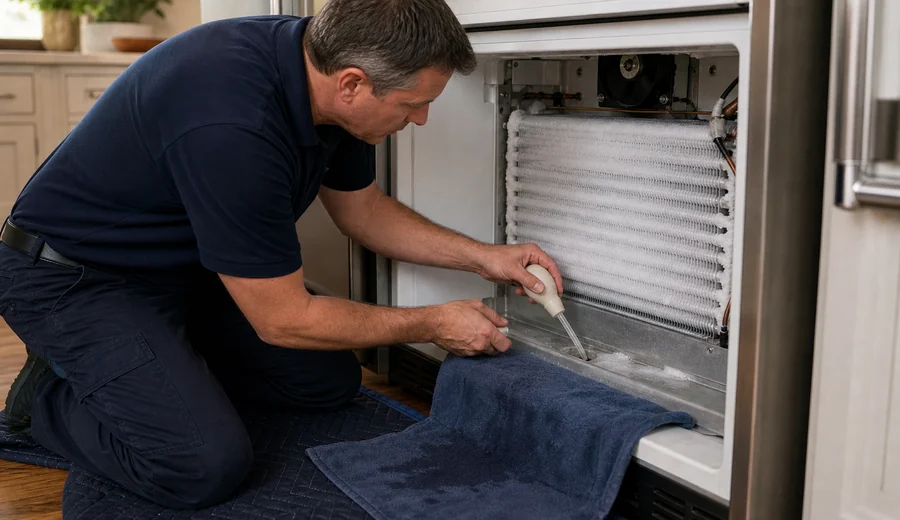
Clearing the drain is straightforward; doing it without cracking a brittle 1990s drain trough takes practice. We steam the line clear, flush it, and check the heater that's supposed to keep it open. If frost is also stacking up on the back wall, the defrost heater or thermostat is likely failing too — a fridge that's losing temperature alongside a leak is usually one root cause showing two symptoms.
Leak to lane
Where the Water Is, What It Costs to Stop
Match the puddle to its source, the first thing to check, and the planning range we'd quote. Every job gets a written number on-site first — these are the ballparks.
| Where the water shows | Likely cause | Typical range |
|---|---|---|
| Ice sheet on the freezer floor | Clogged defrost drain | $250–$550 |
| Steady trickle behind the toe kick | Scaled fill valve or supply fitting | $250–$550 |
| Drips at the filter housing | Cracked housing or crooked filter | $250–$550 |
| Water inside the fresh-food box | Blocked drain path or failed gasket | $550–$1,100 |
| Leak plus frost and a warming box | Defrost heater or thermostat failure | $550–$1,100 |
A leak that arrives with rising temps is usually one root cause showing two faces — cross-check it against the not-cooling triage before you assume two separate repairs.
On arrival
What the Tech Does First on a Leak Call
A leak is a hunt, not a guess — water travels before it pools, so the diagnosis works backward from the puddle to the source.
- Confirm clear versus dirty water. Clear points at the supply line or defrost drain; cloudy or food-flecked points inside the box. That single call narrows the field by half.
- Run the supply-off test in reverse. If you already killed the water and the leak stopped, it's confirmed supply-side. If you didn't, we do it on the spot.
- Inspect the defrost drain and pan. Check the tube for ice or gum, verify the drain heater, and look for an overflowing evaporation pan — the old-cottage classic.
- Pressure-check the fill valve and housing. On 14–28 grain water, scale on the valve seat is the usual culprit; we test whether it fully closes after the fill cycle.
- Drag-test the gaskets. A dollar bill that slides out clean means humid beach air is condensing inside — a seal job, not a plumbing one.
Scale-driven leaks usually travel with slow or hollow ice, so the ice maker repair page is the companion read; pricing for every lane above sits in the cost guide.
Damage control
Three Moves Before We Arrive
- Kill the water supply if the leak is clear water and active — quarter-turn valve under the sink or behind the toe kick.
- Protect the floor. Towels plus a shallow pan under the drip line. Built-ins hide seepage against the cabinetry, and beach-cottage hardwood doesn't forgive.
- Note what the unit was doing — ice production, defrost timing, any error codes. Thirty seconds of detail shortens the visit, and the visit is what you pay for.
We cover every street in 32250 — check the coverage rundown if you're on the edges — and leak calls get same-week priority because of what water does to kitchens. Curious what the ticket might run before you book? The pricing guide has the full table.
Leak questions
What Jax Beach Owners Ask About Leaks
Why is there an ice sheet under my Sub-Zero freezer basket?
Classic clogged defrost drain. Every defrost cycle melts frost off the evaporator; the meltwater is supposed to run down a drain tube to an evaporation pan. When the tube gums up or freezes shut, the water refreezes into a sheet on the freezer floor, then overflows onto your kitchen floor. Older units have run thousands of defrost cycles, so the drain is a prime suspect.
Is water pooling under a built-in Sub-Zero an emergency?
Treat it as urgent, not catastrophic. The leak itself is usually a slow drip, but built-ins sit flush against cabinetry, and a week of seepage will wreck toe kicks and warp hardwood — expensive in a renovated cottage kitchen. Towel it up, find the supply valve if you can, and get on the schedule within a day or two.
Could hard water be behind my Sub-Zero's leak?
Around Jacksonville Beach, very often. Local water runs 14 to 28 grains per gallon — among the hardest in Florida — and scale builds inside the ice maker fill valve until it can't seal fully. A valve that won't close keeps trickling water after the fill cycle, which overfills the mold and ends up on your floor. A valve swap plus a filter change usually ends it.
Do I need to shut the water off before the tech arrives?
If the puddle is active and clear, yes — find the saddle or quarter-turn valve on the supply line, usually under the sink or behind the toe kick, and close it. The fridge keeps cooling fine without water; you only lose ice production and the dispenser. If the leak stops when the water is off, you've also just confirmed it's supply-side, which speeds our diagnosis.
How can I tell a defrost-drain leak from a fill-valve leak myself?
Shut the water supply off and watch for a day. If the leak stops, it's supply-side — a fill valve or fitting trickling after each ice cycle, common on our 14–28 grain water. If it keeps coming with the water off, it's the defrost drain: meltwater that can't reach the evaporation pan, freezing on the freezer floor and overflowing. One test, two very different repairs.
Could the water under my fridge actually be condensation rather than a leak?
At the beach, sometimes yes. Year-round humidity condenses on any cabinet that's lost gasket seal or door-heater function, and the drips collect at the base looking exactly like a leak. The tell is location and timing: a true leak traces to the drain or the water line; condensation shows up on the door exterior and worsens on muggy days. We check the gasket with a dollar-bill drag test before chasing a phantom drain.