Ice makers · Jacksonville Beach
Sub-Zero Ice Maker Repair in Jacksonville Beach
For Sub-Zero repair in Jacksonville Beach, call (904) 650-0561 or book online — seven days a week, 8 a.m. to 8 p.m.
Reviewed and current as of June 13, 2026.
The hard-water angle
Why Jax Beach Ice Makers Quit Early
Almost every ice maker call in 32250 comes back to one thing: minerals. The supply here runs 14 to 28 grains per gallon, among the hardest in Florida, and scale is patient. It builds in the places that matter most.
Hard water leaves chalky deposits inside the fill valve, the fill tube, and the cartridge filter. The valve narrows until it can no longer pass a full charge of water, so cubes shrink, then hollow out, then stop. The same scale clouds the cubes you do get and dulls the taste of the water at the dispenser. None of it means the machine is dead — it means it is clogged, and clogged is fixable.
On the harvest side, the ice maker module — the motor, gear, and thermostat that eject finished cubes — wears on a separate clock. When water still fills but the cubes never drop, that module is the suspect, not the valve. We test fill volume and module operation in the first ten minutes so the right part rides out on the first trip. The cost guide shows how the lanes split.
Plain numbers
Ice Symptom, First Check, Cost Lane
Find the symptom, see what we test first, and know the lane before we ring the bell. Planning figures — the written quote on-site is the exact one.
| Symptom | First check on-site | Cost lane |
|---|---|---|
| No ice, fridge still cold | Fill valve flow, water pressure, filter | $200–$500 |
| Small, hollow, or slow cubes | Scaled valve, clogged fill line, filter age | $200–$450 |
| Water fills but no cubes drop | Ice maker module, thermostat, harvest motor | $350–$700 |
| Cloudy or off-tasting ice | Filter replacement, line and valve descale | $200–$400 |
| Bin overflowing or ice sheeting | Valve stuck open, fill tube freeze | $250–$550 |
What we actually do
A Real Ice Maker Visit, Step by Step
No guessing, no parts cannon. The visit follows the water from the wall valve to the finished cube, and most of it happens with the bin out and a meter in hand.
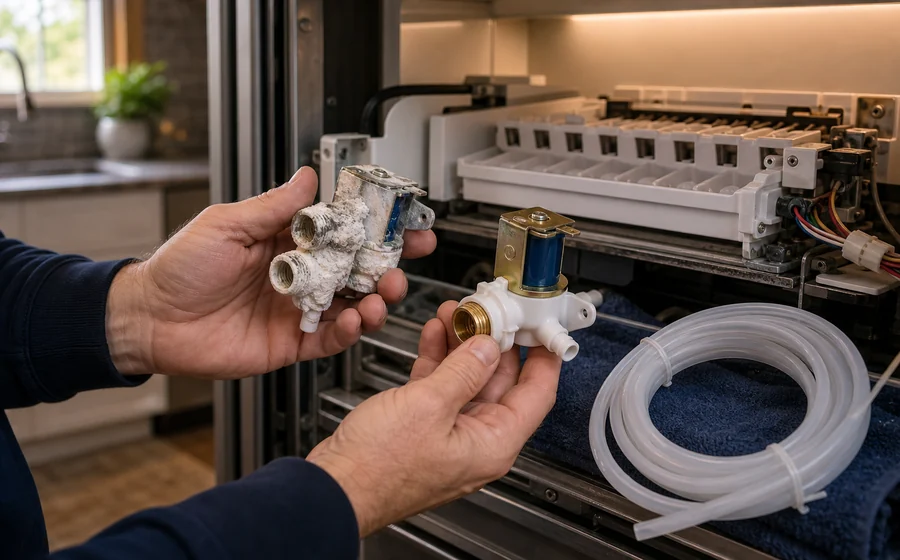
- Measure the fill. We catch and time the water charge. A short fill points straight at a scaled valve, a clogged line, or a spent filter — the hard-water trio.
- Check the filter and line. In 32250 the cartridge loads fast. We pull it, read its age, and descale the fill tube if minerals have narrowed it.
- Run the module through a harvest. If water gets in but nothing ejects, the motor, gear, or thermostat in the module is the fix — tested, not assumed.
- Confirm a clean shut-off. The last step is watching the valve close fully so the bin does not overfill and freeze into a sheet a week later.
Working on a built-in unit? The BI-series page covers the integrated ice maker and its water valve in detail. If the leak turns out to be a drain rather than the ice maker, the leaking-water guide picks it up, and we run every street across the 32250 service area.
The parts bin
Parts We Replace on a Scaled-Up Ice Maker
Almost every ice maker part on the truck for a 32250 call traces back to 14-to-28-grain hard water working the water side hard. Here is what gets swapped most, and what each one does.
| Part | Symptom it causes | Why it fails in 32250 |
|---|---|---|
| Water inlet valve | Shrinking, hollow, then no cubes | Scale narrows the valve until it cannot pass a full charge |
| Water filter cartridge | Slow ice, cloudy cubes, flat-tasting water | Hard water loads the cartridge well before the six-month mark |
| Ice maker module | Water fills but cubes never eject | Harvest motor, gear, or thermostat wears on its own clock |
| Fill tube / line descale | Trickle fill, undersized cubes | Mineral builds inside the tube where the water sits coldest |
| Solenoid (stays energized) | Bin overflow, ice sheet under the basket | A valve that will not fully close after a long fill cycle |
On built-in units the solenoid can fault if it stays energized past roughly fifteen seconds, which is why we always confirm a clean shut-off. The BI-series page covers the integrated maker and its valve where the unit is flush in cabinetry.
Two causes, one symptom
Module vs. Valve: Telling the Two No-Ice Causes Apart
"No ice" splits into two completely different repairs. The deciding question is simple: does water reach the mold at all? A timed fill answers it in the first ten minutes.
| What the fill test shows | Where the fault is | Cost lane |
|---|---|---|
| Trickle or no water into the mold | Scaled inlet valve, clogged line, or spent filter | $200–$500 |
| Full charge fills but no cubes drop | Ice maker module — motor, gear, or thermostat | $350–$700 |
| Water keeps running after the mold is full | Valve stuck open from scale — bin overflows | $250–$550 |
| Cubes form but come out small and cloudy | Partial scale plus an old filter | $200–$400 |
Because the water side and the harvest side fail independently, testing both separately keeps you from paying for a module when a valve is the culprit. If the symptom is really water on the floor, the leaking-water guide sorts a drain from a valve, and a same-day booking is always open.
Case Note: Ocean Forest, the Shrinking Cubes
Educational diagnostic scenario — a composite of common Jax Beach calls, not a customer review
A BI-36UFD in an Ocean Forest kitchen: cubes had shrunk to half size over a couple of months, then went hollow, then quit. The fridge held 38°F throughout. A timed fill caught barely a trickle — the inlet valve had scaled nearly shut, and the filter, eight months old, was loaded with the area's mineral content.
New inlet valve, fresh filter, a descale of the fill line, and a confirmed full charge. Cubes came back to full size within a day, clear again. The ticket landed in the low hundreds. The lesson at the beach: shrinking cubes are a water-flow story, and water flow is almost always scale.
Good questions
Ice Maker Questions From the Beach
My ice maker stopped making ice but the fridge is cold — where do I look first?
Two things stall a Sub-Zero ice maker most: a scaled-up water inlet valve and a faulty module. Hard Jacksonville water leaves mineral deposits that slowly choke the fill valve until no water reaches the mold. If water gets in but the harvest never fires, the module's motor or thermostat is the suspect. We test fill volume first, then the module — it tells us the lane in minutes.
Why does my ice taste off or come out cloudy here at the beach?
Cloudy or flat-tasting ice is almost always a water-quality story, not a broken machine. Jacksonville's supply runs 14 to 28 grains per gallon — among the hardest in Florida — and that mineral load clouds cubes and dulls flavor. A spent filter or a scaled fill line makes it worse. Fresh filter, a descale of the line and valve, and the cubes clear up.
How often should the ice maker water filter get changed in 32250?
Sub-Zero's default is roughly every six months, but our local water shortens that. With 14-to-28-grain hardness loading the cartridge faster, we usually suggest checking it at four to five months at the beach. A clogged filter starves the fill valve, drops cube size, and eventually leaves you scooping store bags — a cheap part that prevents a service call.
The ice maker is overflowing and leaking — is that the same kind of fix?
Different cause, related part. A valve stuck partly open from scale keeps feeding water after the mold is full, so it spills and freezes into a sheet under the bin. We replace the inlet valve, clear the fill tube, and confirm a clean shut-off cycle. If the leak is pooling on the floor rather than in the bin, the defrost drain may be the culprit instead.
Do you service the standalone UC-15I undercounter ice machines too?
Yes — the undercounter ice makers are their own animal, and beach summer kitchens love them. The UC-15I scales heavily in our hard water, the gravity drain clogs, and a tight cabinet starves the condenser. We descale the system, clear the drain, check the condenser, and sort the gravity-versus-pump drain setup so the machine cycles clean again.
Will a whole-house water softener stop my Sub-Zero ice maker from scaling up?
It helps a lot. Softening the supply ahead of the unit cuts the mineral load that narrows the fill valve and loads the filter, and on 14-to-28-grain beach water that is the single biggest driver of repeat ice-maker calls. It does not replace the cartridge filter the unit still needs, and existing scale already inside the valve and fill line has to be cleared, but going forward it slows the cycle down dramatically.
How long should a Sub-Zero ice maker take to refill the bin after a repair?
Give it about 24 hours to fully restock and to confirm the harvest cycle is steady. A healthy Sub-Zero maker drops a batch every couple of hours once the mold reaches temperature, so the bin climbs gradually rather than all at once. We watch at least one full fill-and-harvest cycle on-site, then check cube size and a clean valve shut-off before we leave.
My cubes smell or taste like the freezer — is that the ice maker or the water?
Usually neither part is broken. Sub-Zero ice is porous and absorbs odors from stored food, and a stale bin or an old filter makes it worse. We replace the cartridge, descale the fill path so minerals are not holding flavor, and recommend dumping the first full bin after any filter change. If an off taste survives a fresh filter and a clean bin, then we look harder at the supply line.