Refrigerators · Jacksonville Beach
Sub-Zero Refrigerator Repair in Jacksonville Beach
For Sub-Zero repair in Jacksonville Beach, call (904) 650-0561 or book online — seven days a week, 8 a.m. to 8 p.m.
Reviewed and current as of June 13, 2026.
The method
How We Diagnose a Warm Sub-Zero
Airflow first, electrical second, refrigerant last. The cheap failures are also the common ones, so the diagnosis runs in cost order — nobody should pay sealed-system money for a fan problem.
- Verify temps with our own gear. The display can lie; a drifted sensor reads fine while the milk says otherwise. The target is 38°F in the fresh-food section.
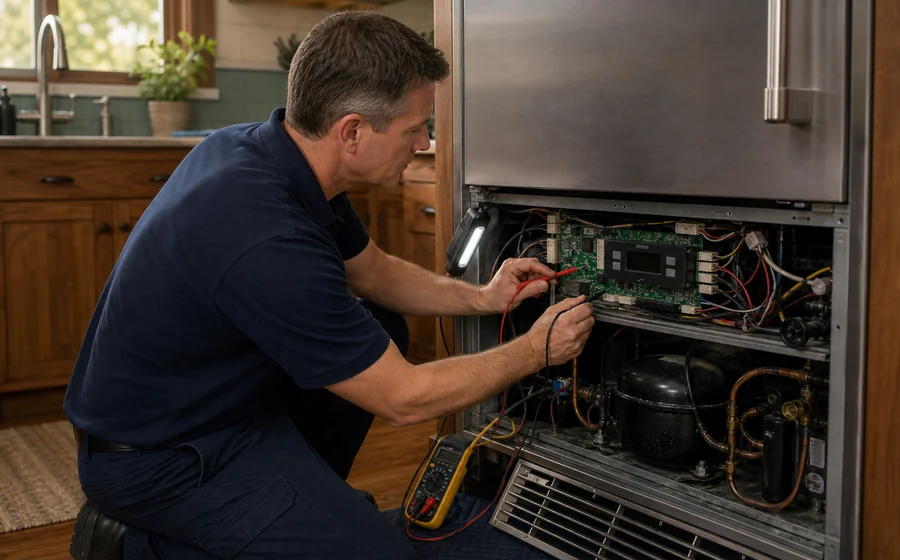
- Pull the grille. Condenser condition and fan operation tell us inside ten minutes whether the unit can shed heat. At the beach, corroded fins are a daily find.
- Read the board. Error history — EC50, EC40, sensor faults — plus a power-rail check separates a confused board from a dead one.
- Test the air movers and sensors. Evaporator fan, thermistors, defrost components: the parts behind most warm-fridge calls in 32250.
- Prove refrigerant problems before quoting them. Pressure readings and frost evidence come first — a frost line covering only the first few inches of the evaporator is the classic leak signature.
You get a written number before any part goes in. If two repairs both make sense, you get both numbers and the honest trade-off — the full repair pricing guide shows how the lanes break down.
Plain numbers
Symptom, First Check, Cost Lane
Find your symptom, see what we test first, and know the lane before we ring the doorbell. Planning figures — the written quote is exact.
| Symptom | First check on-site | Cost lane |
|---|---|---|
| Fridge warm, freezer cold | Evaporator fan spin, thermistor readings | $250–$1,100 |
| Both sides warm after a storm | Board power-up test, error history | $550–$1,100 |
| Runs nonstop, never satisfied | Condenser condition, door-seal drag | $250–$550 |
| Food freezing on fridge shelves | Thermistor drift, control calibration | $550–$1,100 |
| Partial frost on the evaporator | Sealed-system pressure check | $1,500–$3,000 |
Local conditions
What 32250 Does to a Refrigerator
Refrigeration at the beach fights three enemies the suburbs never see. Knowing which one is beating on your unit is half the repair.
Salt fog east of 3rd Street
The closer you live to the sand, the faster condenser fins corrode. Oceanfront units along 1st Street South can lose serious heat-shedding capacity within a couple of seasons, and a hot condenser drags the whole refrigerator down with it. Tighter cleaning intervals are the cheapest insurance this side of the dune line.
Surges after the outage
Northeast Florida stacks up 100-plus thunderstorm days a year, and the damage usually rides in on the restoration surge — a spike that can run 50 to 100 percent over normal line voltage when power slams back. The BI-series built-ins from the teardown-rebuild years are especially prone to locked or dead boards afterward.
Cottage alcoves run hot
The mid-century cottages around the pier and South Beach Park hide serious kitchens behind small footprints, and the remodels often boxed the refrigerator into an alcove with barely an inch of breathing room. Starved ventilation means longer compressor runs, hotter boards, and earlier failures — a pattern we see weekly on this side of the Intracoastal.
Freezer side acting up instead? The freezer service page walks the same triage for the cold half. Still in the maybe-it-recovers stage? Work the not-cooling checklist before you book — and yes, we run every street in the 32250 coverage area, pier to the Ponte Vedra line.
The parts bin
Parts We Replace Most on a Beach Fridge
On a refrigerator service in 32250, five parts account for the large majority of fridge-side tickets. Knowing which one is failing is the difference between a mid-hundreds visit and a four-figure one.
| Part | Symptom it causes | Why it fails in 32250 |
|---|---|---|
| Evaporator fan motor | Fridge warm, freezer still at 0°F | Runs nonstop in long compressor cycles caused by alcove heat |
| Thermistor (temp sensor) | Food freezing on shelves, or warm with a clean display | Drifts with age; the panel reads the sensor, not the air |
| Main control board | Both sides warm, blank or scrambled panel | Restoration surge after a lightning-belt outage |
| Condenser fan and coil | Runs constantly, EC50, never satisfied | Salt-fog corrosion off the dune line wrecks heat rejection |
| Door gasket | Condensation, frost, compressor overrun | Salt and humidity harden the seal in three to four seasons |
A 38°F fresh-food target and a 0°F freezer are the specs we measure against; anything more than a couple of degrees off after a 24-hour stabilization window means a part, not a setting. The BI-series breakdown shows how board availability moves the number on newer built-ins.
Before you book
When to Call vs. What You Can Try First
A warm Sub-Zero is not always a service call. Two minutes of checking can tell you whether this is a five-minute reset or a real failure — and either way it makes the visit faster.
- Confirm power and the breaker. Sub-Zeros often share a dedicated circuit; a tripped breaker after a storm reads as a dead unit. Reset it once and watch the panel come back.
- Give a recent move or restock 24 hours. A unit that was just loaded, relocated, or had its doors open during a remodel needs a full stabilization window before you judge the temperature.
- Vacuum the condenser if you can reach it. Behind the lower grille, a coil clogged with salt dust and lint is the cheapest fix there is — and it clears a surprising number of EC50 complaints.
- Call when the panel is blank, codes persist, or it is over 45°F. Those point at a board, sensor, or sealed-system fault that needs instruments, not a reset — and food safety has a clock.
When it crosses into real-repair territory, the not-cooling triage page walks the warm-unit decision in more depth, and a same-day slot is one booking request away, seven days a week.
Case Note: Ocean Forest, After the Tuesday Storms
Educational diagnostic scenario — a composite of common Jax Beach calls, not a customer review
A 2013 BI-36U in an Ocean Forest kitchen: fridge at 49°F by morning, freezer holding 0°F, power had blinked twice overnight. Error history showed nothing and the board's power rails tested clean — so this wasn't the storm's doing. The fridge-side evaporator fan was seized solid.
One fan, one thermistor verified within spec, and temps were back to 38°F within a day. The ticket landed mid-hundreds, not four figures. The lesson: a warm fridge over a healthy freezer points at the fridge circuit, and the fix is usually electrical — not refrigerant.
Good questions
Refrigerator Questions From the Beach
Do you fix the fridge side without touching the freezer side?
On most built-ins, yes. Sub-Zero runs separate cooling circuits for each compartment, so we diagnose and repair the failed side on its own while the freezer keeps holding your food at temp. That split design is also why a warm fridge over a working freezer is such a useful clue — it rules out half the machine before we even open the truck.
How often should an oceanfront Sub-Zero get its condenser cleaned?
Sub-Zero's guidance is every six to twelve months, and that holds up fine west of 3rd Street. Within a few blocks of the sand we recommend doubling the schedule. Salt fog corrodes condenser fins, and a corroded coil sheds heat poorly even when it looks clean from the front. Units along 1st Street South get the shortest interval we quote anywhere.
Is a 25-year-old 600-series refrigerator still worth repairing?
Run the math before deciding either way. A thermistor or evaporator fan on a 632 or 650 is a few hundred dollars against a five-figure replacement — plus cabinetry work to fit a new box into the old cutout. Sealed-system repairs change the equation at $1,500 to $3,000, but even then the repair often wins in a cottage kitchen built around the original unit.
What should I check before calling about a warm refrigerator?
Three things speed everything up: confirm the breaker hasn't tripped, note exactly what the control panel shows — codes, dashes, or nothing at all — and grab the model and serial from the tag just inside the door frame. Tell us those on the phone and the right parts ride out on the first visit instead of the second.
How long should it take a repaired Sub-Zero to get back down to 38°F?
Plan on a full 24 hours before you judge it. Sub-Zero calls out a 24-hour stabilization window after any cooling repair, and a box that drifted warm has to pull a fully loaded, room-temperature cabinet back down. We leave it running, confirm the fridge circuit holds 38°F and the freezer 0°F, and tell you what the display should read by the next evening.
Does a refrigerator boxed into a tight cottage alcove need anything special?
It needs breathing room more than parts. The mid-century remodels around the pier often dropped a full-size Sub-Zero into an opening with barely an inch of clearance, so the heat it sheds has nowhere to go. That drives long compressor runs and early board and fan failures. On those installs we check the condenser airflow first and, where we can, open up the ventilation behind the grille.
Can you tell over the phone whether my warm fridge is a fan or a sealed-system problem?
Often we can narrow it. A warm fridge over a freezer still holding 0°F almost always points at the fridge-side evaporator fan or thermistor — an electrical fix in the mid-hundreds. Both compartments warm together, or a frost line that dies off after the first few inches of the evaporator, leans toward refrigerant. We confirm with pressure and electrical readings on-site before quoting either lane.